


Last Quarter Performance
Over the most recent quarter, the AUDUSD has broadly traded in a relatively narrow range, with a bias to the topside, so buy on dips strategies have played out well for traders. While volatility has spiked around major data releases, broad USD sentiment and global risk trends have largely cushioned big directional moves. The AUD has seen strength on softer USD phases and strong domestic data prints, though it remains sensitive to global shifts and US macro developments. The major pair is now trading off recent multi-month highs set early in the year, and the currency remains at elevated levels on the crosses.
Domestic Update
Australia’s economy showed real growth in Q3 2025, with GDP up 0.4% quarterly and 2.1–2.2% annually, however, this was below the expected 0.7% increase, which disappointed somewhat. Household consumption, dwelling investment, and business spending were again notable contributors.
Inflation prints dipped in the new year but remain sticky: headline CPI dropped to 0 % m/m vs expected +0.1%, with annual inflation dropping 0.2% to 3.4%, still well above the RBA’s 2–3% target. The trimmed mean CPI, however, did push higher, rising 0.3% m/m.
Labour market indicators from November show unemployment near 4.3%, with solid job creation, and are expected to remain at that level for the December data, while the Employment Change is expected to show a 20k decrease in the month-on-month data.
Reserve Bank of Australia Expectations
The RBA has held the cash rate at 3.60%, shifting its stance toward a more hawkish bias as inflation surprises linger and growth stabilises. Market pricing now leans toward rate hikes in mid-2026, in line with the sticky inflation conditions.
Recent RBA commentary continues to emphasize the data-dependent nature of future decisions, especially around inflation persistence versus signs of any labour market weakening.
Geopolitics
• Global trade uncertainty remains elevated amid tariff deliberations and geopolitical concerns in major economies; this continues to act as an external risk factor that weighs on cyclical FX like AUD.
• Shipping and commodity flows still face intermittent disruption, especially in the current environment – Venezuela, Iran, Iraq, and the US – feeding into risk sentiment swings that often moderate AUD moves alongside global growth cues. Gold and Silver momentum to new highs should continue to remain supportive of the AUD.
• China’s growth dynamics persist as a key external driver — with iron ore and broader commodity demand outlooks still viewed as highly influential for AUD performance.
Next Quarter
• Rate vs. data tug-of-war: Elevated inflation readings and resilient growth imply that the RBA may move to a tightening cycle in the coming quarters. Future inflation prints and labour data will be key to pricing and policy signals. If inflation data continues to remain strong, then expect the Aussie to remain bid on dips, especially on cross-currency pairs.
• External headwinds: Global growth uncertainty, tariff/legal outcomes, and broad USD dynamics will continue to influence AUDUSD ranges. Geopolitical updates look certain to influence the Aussie in the short term, with any positive updates likely to add support to the currency, whilst further issues will lead to pressure and the potential for strong downside moves.
Trading Expectations
• Range-trading with headline risk: Focus events include updated monthly CPI measures, employment data, and subsequent RBA communications, and major US data releases that drive USD sentiment, as well as FOMC updates, will likely have a strong impact on the major pair, whilst local updates should be more impactful on the crosses.
• Crosses matter: Relative central bank paths and global risk appetite will be significant for cross moves, with longer-term plays now likely to favour a stronger Aussie on most major crosses.
• Event map: Watch forthcoming inflation prints (Monthly CPI Indicator), job market updates, and the next official RBA Statement on Monetary Policy for nuanced guidance on the medium-term trajectory. The skew for the RBA currently sits with a more hawkish agenda.
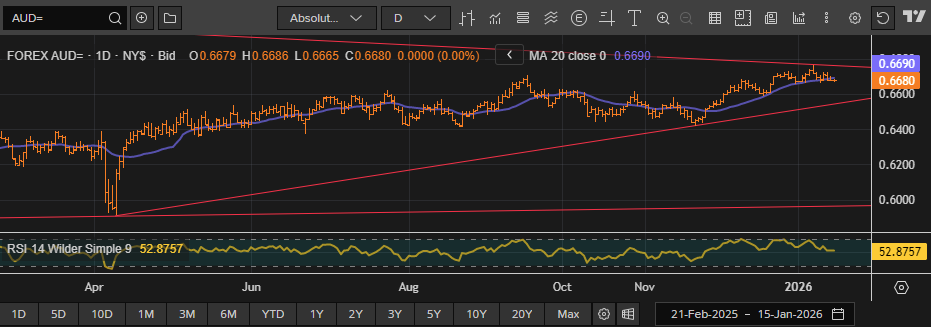
Technical Levels:
Resistance 2: 0.6766 – 2026 High
Resistance 1: 0.6757 – Trendline Resistance
Support 1: 0.6661 – 2026 Low
Support 2: 0.6543 – Trendline Support
